





Before you leave...
Take 20% off your first order
20% off
Enter the code below at checkout to get 20% off your first order

Discover summer reading lists for all ages & interests!
Find Your Next Read
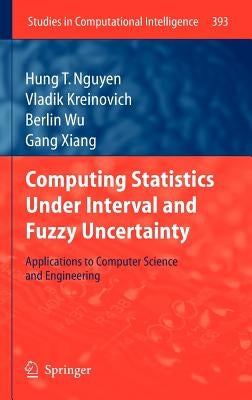
In many practical situations, we are interested in statistics characterizing a population of objects: e.g. in the mean height of people from a certain area.
Most algorithms for estimating such statistics assume that the sample values are exact. In practice, sample values come from measurements, and measurements are never absolutely accurate. Sometimes, we know the exact probability distribution of the measurement inaccuracy, but often, we only know the upper bound on this inaccuracy. In this case, we have interval uncertainty: e.g. if the measured value is 1.0, and inaccuracy is bounded by 0.1, then the actual (unknown) value of the quantity can be anywhere between 1.0 - 0.1 = 0.9 and 1.0 ] 0.1 = 1.1. In other cases, the values are expert estimates, and we only have fuzzy information about the estimation inaccuracy.
This book shows how to compute statistics under such interval and fuzzy uncertainty. The resulting methods are applied to computer science (optimal scheduling of different processors), to information technology (maintaining privacy), to computer engineering (design of computer chips), and to data processing in geosciences, radar imaging, and structural mechanics.
Thanks for subscribing!
This email has been registered!
Take 20% off your first order
Enter the code below at checkout to get 20% off your first order