




Before you leave...
Take 20% off your first order
20% off
Enter the code below at checkout to get 20% off your first order

Discover summer reading lists for all ages & interests!
Find Your Next Read
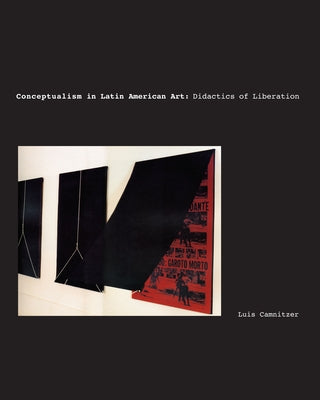
Conceptualism played a different role in Latin American art during the 1960s and 1970s than in Europe and the United States, where conceptualist artists predominantly sought to challenge the primacy of the art object and art institutions, as well as the commercialization of art. Latin American artists turned to conceptualism as a vehicle for radically questioning the very nature of art itself, as well as art's role in responding to societal needs and crises in conjunction with politics, poetry, and pedagogy. Because of this distinctive agenda, Latin American conceptualism must be viewed and understood in its own right, not as a derivative of Euroamerican models.
In this book, one of Latin America's foremost conceptualist artists, Luis Camnitzer, offers a firsthand account of conceptualism in Latin American art. Placing the evolution of conceptualism within the history Latin America, he explores conceptualism as a strategy, rather than a style, in Latin American culture. He shows how the roots of conceptualism reach back to the early nineteenth century in the work of S?on Rodr?uez, S?on Bol?ar's tutor. Camnitzer then follows conceptualism to the point where art crossed into politics, as with the Argentinian group Tucum疣 arde in 1968, and where politics crossed into art, as with the Tupamaro movement in Uruguay during the 1960s and early 1970s. Camnitzer concludes by investigating how, after 1970, conceptualist manifestations returned to the fold of more conventional art and describes some of the consequences that followed when art evolved from being a political tool to become what is known as "political art."
Luis Camnitzer, an award-winning artist, essayist, and critic, is Professor Emeritus of Art at SUNY Old Westbury. He served as Viewing Program Curator at the Drawing Center in New York City from 1999 to 2006. His work is in the permanent collections of major museums in the United States, Latin America, Europe, and the Middle East.
Thanks for subscribing!
This email has been registered!
Take 20% off your first order
Enter the code below at checkout to get 20% off your first order