





Before you leave...
Take 20% off your first order
20% off
Enter the code below at checkout to get 20% off your first order

Discover summer reading lists for all ages & interests!
Find Your Next Read
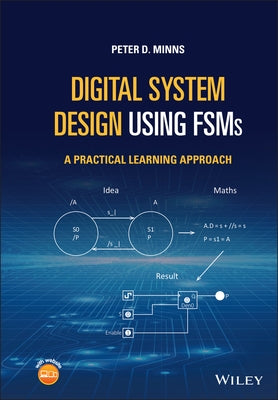
Explore this concise guide perfect for digital designers and students of electronic engineering who work in or study embedded systems
Digital System Design using FSMs: A Practical Learning Approach delivers a thorough update on the author's earlier work, FSM-Based Digital Design using Verilog HDL. The new book retains the foundational content from the first book while including refreshed content to cover the design of Finite State Machines delivered in a linear programmed learning format. The author describes a different form of State Machines based on Toggle Flip Flops and Data Flip Flops.
The book includes many figures of which 15 are Verilog HDL simulations that readers can use to test out the design methods described in the book, as well as 19 Logisim simulation files with figures. Additional circuits are also contained within the Wiley web folder. It has tutorials and exercises, including comprehensive coverage of real-world examples demonstrated alongside the frame-by-frame presentations of the techniques used.
In addition to covering the necessary Boolean algebra in sufficient detail for the reader to implement the FSM based systems used in the book, readers will also benefit from the inclusion of:
Suitable for design engineers and senior technicians seeking to enhance their skills in developing digital systems, Digital System Design using FSMs: A Practical Learning Approach will also earn a place in the libraries of undergraduate and graduate electrical and electronic engineering students and researchers.
Author: Peter D. Minns
ISBN-10: 1119782708
ISBN-13: 9781119782704
Publisher: Wiley
Language: English
Published: 06/28/2021
Pages: 352
Format: Hardcover
Weight: 1.68lbs
Size: 9.61h x 6.69w x 0.81d
Peter D. Minns, PhD, now retired, has over 33 years experience as an academic Senior Lecturer, most recently in the Department of Mathematics, Physics, and Electrical Engineering at Northumbria University at Newcastle, UK. Prior to academia, he worked in the telecommunications industry and in Power System Protection as a Design and Development Engineer.
Thanks for subscribing!
This email has been registered!
Take 20% off your first order
Enter the code below at checkout to get 20% off your first order