





Before you leave...
Take 20% off your first order
20% off
Enter the code below at checkout to get 20% off your first order

Discover summer reading lists for all ages & interests!
Find Your Next Read
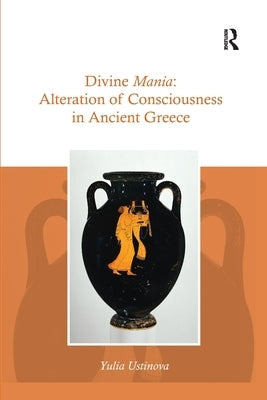
'Our greatest blessings come to us by way of mania, provided it is given us by divine gift, ' - says Socrates in Plato's Phaedrus. Certain forms of alteration of consciousness, considered to be inspired by supernatural forces, were actively sought in ancient Greece. Divine mania comprises a fascinating array of diverse experiences: numerous initiates underwent some kind of alteration of consciousness during mystery rites; sacred officials and inquirers attained revelations in major oracular centres; possession states were actively sought; finally, some thinkers, such as Pythagoras and Socrates, probably practiced manipulation of consciousness. These experiences, which could be voluntary or involuntary, intense or mild, were interpreted as an invasive divine power within one's mind, or illumination granted by a super-human being.
Greece was unique in its attitude to alteration of consciousness. From the perspective of individual and public freedom, the prominent position of the divine mania in Greek society reflects its acceptance of the inborn human proclivity to experience alteration of consciousness, interpreted in positive terms as god-sent. These mental states were treated with cautious respect, and in contrast to the majority of complex societies, ancient and modern, were never suppressed or pushed to the cultural and social periphery.
Author: Yulia Ustinova
ISBN-10: 0367594269
ISBN-13: 9780367594268
Publisher: Routledge
Language: English
Published: 08/14/2020
Pages: 396
Format: Paperback
Weight: 1.05lbs
Size: 9.10h x 6.10w x 0.80d
Yulia Ustinova is Associate Professor at the Department of General History, Ben-Gurion University of the Negev, Israel. Her research focuses on ancient Greek religion and its role within the society. In addition to the study of textual and archaeological sources, her approach is based on the application of results of cognitive neuroscience, anthropology, and sociology to the interpretation of historical phenomena.
Thanks for subscribing!
This email has been registered!
Take 20% off your first order
Enter the code below at checkout to get 20% off your first order