



Before you leave...
Take 20% off your first order
20% off
Enter the code below at checkout to get 20% off your first order

Discover summer reading lists for all ages & interests!
Find Your Next Read
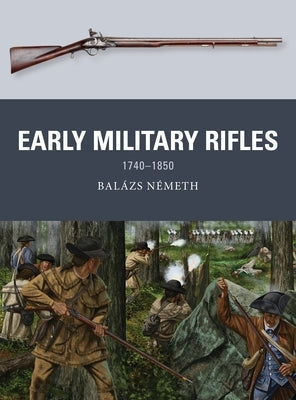
Fully illustrated with specially commissioned artwork, this fascinating study investigates the rifled firearms employed by European and American forces in the 18th and early 19th centuries, from the American long rifle to the British Baker rifle and beyond.
The conduct of combat operations in open order during the 18th and 19th centuries required an improved firearm with more accuracy than the standard-issue smoothbore infantry musket. Consequently, the appearance of a new type of regular light infantry soldier and an innovative military firearm, the rifle, marked a new age in the history of warfare. During the 18th century both Austria and Prussia fielded light troops armed with rifled firearms, while conflicts in North America involved the deadly long rifle and the innovative Ferguson breech-loader. Rifle-armed specialists also fought for several nations during the Napoleonic Wars. However, it was the decades after 1815 that saw the appearance of successful rifled percussion firearms, paving the way for the widespread issue of rifled weapons. This development was accelerated by the Prussian adoption of the Dreyse "needle gun" in 1848 and in 1849, the French Mini rifle was the first successful conical ball rifle concept to be issued to regular troops in large numbers. Illustrated throughout with stunning full-color artwork, this study charts the development, combat use, influence, and legacy of rifled firearms in a host of conflicts, from the War of the Austrian Succession of 1740-48 to the Mexican-American War of 1846-48.Bal痙s N駑eth teaches military history at the Public Service University of Budapest's Faculty of Military Science and Officer Training. He has a particular interest in the infantry tactics and firearms history of the mid-19th century and has published many scientific papers in Hungarian. He is based in Hungary.
Johnny Shumate began his career in 1987 after graduating from Austin Peay State University, and now works as a freelance illustrator. Most of his work is rendered in Adobe Photoshop using a Cintiq monitor. His greatest influences are Angus McBride, Don Troiani, and ノdouard Detaille. Born in Malaya in 1949, Alan Gilliland spent 18 years as the graphics editor of the Daily Telegraph, winning 19 awards in that time. He now writes, illustrates and publishes fiction (www.ravensquill.com), as well as illustrating for a variety of publishers (alangillilandillustration.blogspot.com).Thanks for subscribing!
This email has been registered!
Take 20% off your first order
Enter the code below at checkout to get 20% off your first order