





Before you leave...
Take 20% off your first order
20% off
Enter the code below at checkout to get 20% off your first order

Discover summer reading lists for all ages & interests!
Find Your Next Read
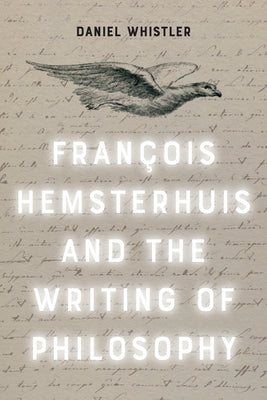
François Hemsterhuis (1721-1790) was the most significant Dutch philosopher after Spinoza. Daniel Whistler argues that Hemsterhuis' philosophy matters and that its exclusion from the canon of modern philosophy has been unjust. This is not just because of its reception history - its influence on later German thinkers, such as Goethe, Hamann, Hegel, Herder, Hölderlin, Jean Paul, Kant, Jacobi, Novalis, Schelling, the Schlegels, Schleiermacher, Wieland - but is primarily because Hemsterhuis' philosophy contains a rich assemblage of ideas and philosophical practices.
Whistler looks specifically at Hemsterhuis' reflections on philosophical style and the strategies he employs to communicate ideas in his late dialogues. Taking seriously Hemsterhuis' newly-published complete correspondence as a significant philosophical text, he contends that Hemsterhuis deserves to be placed alongside Shaftesbury, Hamann, Friedrich Schlegel, Kierkegaard and Nietzsche as one of the preeminent philosophical stylists of modernity.
Daniel Whistler is Professor of Philosophy at Royal Holloway, University of London. He is author and editor of numerous volumes on eighteenth and nineteenth-century philosophy, including the three-volume Edinburgh Edition of the Complete Philosophical Works of Fran?ois Hemsterhuis, The Schelling-Eschenmayer Controversy, 1801: Nature and Identity (EUP, 2020), The Edinburgh Critical History of Nineteenth-Century Christian Theology, The Schelling Reader (Bloomsbury, 2020) and the forthcoming Oxford Handbook of Modern French Philosophy (Oxford University Press, 2022).
Thanks for subscribing!
This email has been registered!
Take 20% off your first order
Enter the code below at checkout to get 20% off your first order