




Before you leave...
Take 20% off your first order
20% off
Enter the code below at checkout to get 20% off your first order

Discover summer reading lists for all ages & interests!
Find Your Next Read
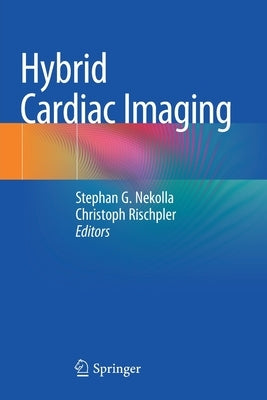
1 Hybrid imaging and health care economics
2 Hybrid imaging and radiation exposure
3 Industry perspective
4 Global/regional peculiarities
PART II SPECT/CT
5 Perfusion, Calcium Scoring, and CTA
6 Innervation/Intervention
7 Novel techniques: solid state detectors, dose reduction
PART III PET/CT
8 Perfusion, flow quantification, FFR
9 Viability
10 Inflammation
11 Novel CT technology
12 Novel PET tracers
PART IV PET/MR
12 Perfusion and viability
13 Inflammation
14 Novel MR technology
Stephan G. Nekolla, PhD, FESC, is adjunct professor and the director of medical physics at the Department of Nuclear Medicine at Technische Universit舩 M?chen (Germany). Dr. Nekolla's research fields are design, acquisition and analysis of PET, SPECT, MRI and CT studies, workflow considerations and quantification methods in clinical and pre-clinical studies. His primary focus is the optimal use of non-invasive imaging to understand the mechanism of disease in cardiology and oncology, their detection and therapy assessment. Especially the use of hybrid devices such as SPECT/CT, PET/CT, and PET/MRI their optimal use in cardiac and oncological imaging is of special relevance.
He is the author/co-author of > 260 peer-reviewed publications, book chapters and review articles (Publons H-index: 60, L-1857-2013).
Dr. Nekolla is chair of the working group medical physics of the German Society of Nuclear Medicine, ESMIT representative of the physics committee of theEuropean Society of Nuclear Medicine and member of the ESC/EACVI Nuclear Cardiology and Cardiac CT Section.
As part of the interdisciplinary imaging network at TU M?chen, he is senior affiliated lecturer at the Chair of Computer Aided Medical Procedures & Augmented Reality (CAMPAR), member of the MunichHeartAlliance as well as member of the German Center of Cardiovascular Research (DZHK).
After studying physics at the University of W?zburg, Germany and his diploma thesis at the Institute of Biotechnology, he received his PhD at the Institute of Physics, University of W?zburg, before moving to Munich.
Christoph Rischpler, MD, is a Consultant at the Clinic of Nuclear Medicine, University Hospital Essen, University of Duisburg-Essen, Germany and holds a professorship for Nuclear Cardiology. He completed his residency at the Department of Nuclear Medicine, Klinikum rechts der Isar, Technische Universit舩 M?chen, Germany where he focused^110peer-reviewed publications, book chapters, and review articles and has an h-index of 28.
Thanks for subscribing!
This email has been registered!
Take 20% off your first order
Enter the code below at checkout to get 20% off your first order