





Before you leave...
Take 20% off your first order
20% off
Enter the code below at checkout to get 20% off your first order

Discover summer reading lists for all ages & interests!
Find Your Next Read
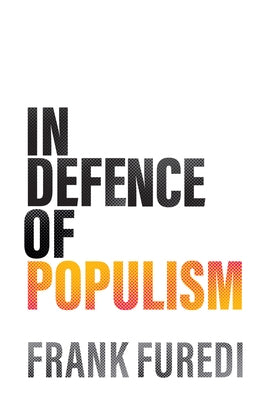
'Populist' is now most commonly used as a term of abuse. Populists, we are repeatedly told, are xenophobic ignoramuses offering irrational, emotive solutions to complex problems. But is this true?
Frank Furedi argues that this is a self-serving narrative that owes more to the desire of elites to protect their own power and interests than it does to the truth. The widespread disdain expressed towards populism in the media and by many academics is in fact poorly concealed contempt towards the idea of popular sovereignty and democratic decision-making. Populism is not equivalent to any specific ideology, as populist politicians vary greatly in their substantive views, but it is rather a broad disposition towards public life that stresses the value of giving the ordinary citizen a genuine voice in political decision-making. Attacks on 'populism' most commonly reveal the desire of those who run our institutions to keep real authority in the hands of unaccountable elites who veil their power under the guise of 'expertise'.
This bracing defence of basic democratic values by one of our most fearless polemicists should be read by anyone who mistakes the complacent assurances of our elite for the wisdom of our betters.
Frank Furedi, author and social commentator, is Emeritus Professor of Sociology at the University of Kent. Author of more than 26 books, Furedi's studies have been devoted to an exploration of the cultural developments in Western societies. His most recent book, The War on the Past (Polity, 2024), was a lively attack on attempts by progressives to render our historical inheritance toxic.
His research has been oriented towards the way that risk and uncertainty are managed by contemporary culture. His two influential books, The Culture of Fear and Paranoid Parenting, investigated the interaction between risk consciousness and perceptions of fear, trust relations and social capital in contemporary society.
Thanks for subscribing!
This email has been registered!
Take 20% off your first order
Enter the code below at checkout to get 20% off your first order