
![Spider-Men: Worlds Collide [Marvel Premier Collection] by Bendis, Brian Michael](http://www.whiterainbookhouse.com/cdn/shop/files/img_2d0d0a87-9d07-4ffd-84f2-c4b241596800_533x.jpg?v=1762317878)




Before you leave...
Take 20% off your first order
20% off
Enter the code below at checkout to get 20% off your first order

Discover summer reading lists for all ages & interests!
Find Your Next Read
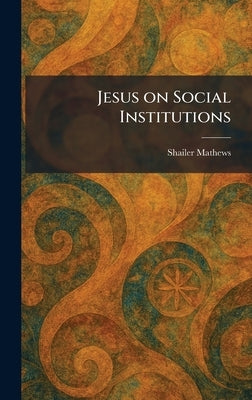
"Jesus on Social Institutions" is a compelling examination of the sociological implications found within the life and teachings of Jesus Christ. Written by Shailer Mathews, a prominent figure in the Social Gospel movement, this work explores how the spiritual principles of the Kingdom of God intersect with and transform the fundamental structures of human society.
Mathews provides a rigorous analysis of Jesus's perspectives on the family, the state, economic life, and the broader social order. Rather than viewing the Gospel through a purely individualistic lens, the author argues that the message of Jesus provides a foundational framework for addressing the complexities of collective human relationships and social reform. By grounding his study in the historical and social context of the New Testament, Mathews illustrates how the revolutionary ethics of the New Testament serve as a catalyst for social evolution and justice.
This scholarly and insightful study remains an essential contribution to Christian sociology and theological ethics. It offers a profound look at how faith can be applied to the challenges of organized society, making it a valuable resource for those interested in the historical development of the Social Gospel and the enduring relevance of Christian social thought.
This work has been selected by scholars as being culturally important, and is part of the knowledge base of civilization as we know it. This work was reproduced from the original artifact, and remains as true to the original work as possible. Therefore, you may see the original copyright references, library stamps (as most of these works have been housed in our most important libraries around the world), and other notations in the work.
This work is in the public domain in the United States of America, and possibly other nations. Within the United States, you may freely copy and distribute this work, as no entity (individual or corporate) has a copyright on the body of the work.
As a reproduction of a historical artifact, this work may contain missing or blurred pages, poor pictures, errant marks, etc. Scholars believe, and we concur, that this work is important enough to be preserved, reproduced, and made generally available to the public. We appreciate your support of the preservation process, and thank you for being an important part of keeping this knowledge alive and relevant.
Thanks for subscribing!
This email has been registered!
Take 20% off your first order
Enter the code below at checkout to get 20% off your first order