





Before you leave...
Take 20% off your first order
20% off
Enter the code below at checkout to get 20% off your first order

Discover summer reading lists for all ages & interests!
Find Your Next Read
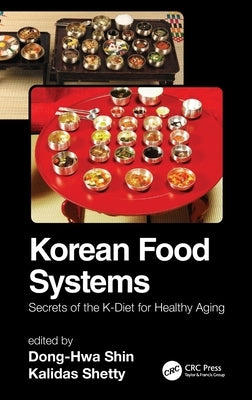
The Republic of Korea (ROK) is projected by 2030 to have the longest living population compared to any nation on earth. A girl born in the ROK in 2030 will live up to 90.8 years on average. What are the reasons for this improvement in longevity?
Among many insights for longevity among the people of the ROK is the diverse Korean ethnic diet with roots in a traditional diet that has been preserved for centuries. Korean Food Systems: Secrets of the K-Diet for Healthy Aging provides an integrated and holistic approach towards the understanding how food systems of the ROK and experiences of the last 60-plus years has been sustained by traditions and ecology integrated with contemporary advances in technology and the economy.
Key Features:
As a collaboration between various outstanding authors, the insights from this book can provide global examples to align similar approaches and policies in other countries in different ecologies of planet earth.
Author: Dong-Hwa Shin
ISBN-10: 1032231122
ISBN-13: 9781032231129
Publisher: CRC Press
Language: English
Published: 09/19/2022
Pages: 228
Format: Hardcover
Weight: 1.16lbs
Size: 9.21h x 6.14w x 0.63d
Dr. Kalidas Shetty is currently the Associate Vice President for International Partnerships & Collaborations and Founding Director of Global Institute of Food Security and International Agriculture-GIFSIA & Professor of Plant Sciences at North Dakota State University, Fargo, ND, USA. Dr. Shetty's research interests focus on critical role of cellular and metabolic basis of oxygen biology for advancing new innovations in Life Sciences and especially Agricultural and Food Innovations that advance global food security and health in a sustainable environment.
His specific research interests focus on scientific, educational and policy strategies to advance climate resilient health-targeted food security solutions including malnutrition and hunger challenges. In particular, he has developed an innovative "climate resilient crops for health" research platform to counter diet-linked non-communicable chronic diseases (NCD). He has published over 225 manuscripts in peer-reviewed journals and over 50 as invited reviews and in conference proceedings with H-Index of 75 on Google Scholar.
In 2004, he was selected by US State Department as the inaugural Jefferson Science Fellow to advice on scientific issues as it relates to International Diplomacy and International Development. Dr. Shetty has widely traveled and has been invited to present lectures and seminars in the areas of Food Biology, Climate Resilient Healthy Food Systems for Food Security & Health and Food Safety in over 50 countries in Asia, Europe, Africa, and the Americas. He also has deep commitment to global education capacity building.
His current passion is to advance research, education capacity building and policy on "sustainable and ecological basis for climate resilient healthy food systems and food diversity to drive global food security. This vision is based on crops and food diversity, indigenous wisdom, traditional fermentations, and new technology innovations in ethnic and indigenous food systems that incorporates understanding of comparative cellular biochemistry of plant and animal systems and their interactions with microbial systems in diverse ecologies and cultures of earth. This system based integrated model and research platform based on cellular basis of oxygen biology of food plants and plant-microbial interactions is the basis for new and innovative sustainable agriculture and food solutions to advance climate resilient and health-targeted food security.
Dong-Hwa Shin, PhD is an emeritus professor of Chonbuk National University in Jeonju, Korea. He has his Ph. D in Food Science & Technology at Dongguk University, Seoul, Korea, He has 18 years' experience in food research field at Food Research Institute in AFDC which is first Korean government supported food research organization. At this institute he carried out many industries-oriented research and applied research. After working at the institute, he transferred to Chonbuk National University in Dept. of Food Science & Technology and served for 22 years.
During this time, he published 350 research papers, 15 patents and 23 books. He managed a Regional Research Center (RRC) for supporting food industry in the region which was fully supported by Korean government for 10 years. His major field is food fermentation, especially soybean and vegetable-based fermentation. Based on his research he transferred 30 relevant techniques to the related industries to be commercialized. He had served as advisor of different Governmental organizations and private food manufacturing companies including CJ and Nongshim, which are the biggest companies in Korea. He was a UNDP/FAO consultant for food industry development at Southeast Asian countries (1983). He is a member of Korean Academy of Science & Technology (KAST), the president of Korean Society of Food Science Technology (2002), President of Korean Society of Food Hygiene and Safety, President of Korean Association of Food Sanitation (2004-2016). and President of Food Safety Association. At present he is the president of Korean Council for Sunchang Soybean Fermentation, the president of Korea Food Industry Promotion Forum, and running Shindonghwa Food Research Institute as Director.
Thanks for subscribing!
This email has been registered!
Take 20% off your first order
Enter the code below at checkout to get 20% off your first order