





Before you leave...
Take 20% off your first order
20% off
Enter the code below at checkout to get 20% off your first order

Discover summer reading lists for all ages & interests!
Find Your Next Read
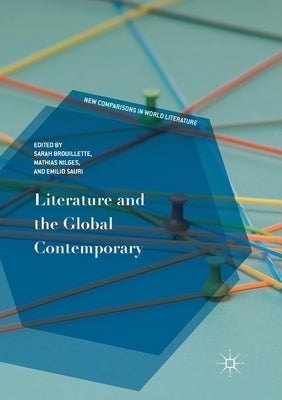
1. Introduction: "Contemporaneity: On Refusing to Live in the Moment"; Sarah Brouillette, Emilio Sauri, and Mathias Nilges.- 2. "The Landowner's Ghosts: Realism and Financialization in Contemporary Latin American Fiction"; Ericka Beckman.- 3. "'Special Period'-izing Cuba: Limits of the Past Perfect"; Jonathan Dettman.- 4. "Autonomy after Autonomy, or the Novel beyond Nation: Roberto Bola's 2666"; Emilio Sauri.- 5. "#YOLO"; Sarah Brouillette.- 6. "Capitalism's Long-Spiral: Periodicity, Temporality, and the Global Contemporary in World-Literature"; Sharae Deckard.- 7. "The Technical Composition of Conceptualism"; Joshua Clover.- 8. "The Multitemporal Contemporary: Colson Whitehead's Presents"; Daniel Grausam.- 9. "Periodizing the Anglophone African Novel: Location(s) in a Transnational Literary Marketplace"; Madhu Krishnan.- 10. "Juggling the Dialectic: The Abyss of Politics in Chris Abani's Fiction"; Mitchum Huehls.- 11. "Contemporaneity and Contradiction: Uneven Temporal Development in Bridgett M. Davis's Into the Go-Slow and Okey Ndibe's Foreign Gods Inc."; Mathias Nilges.- Index.
Sarah Brouillette is Professor of English at Carleton University in Ottawa, Canada. She is the author of Postcolonial Writers in the Global Literary Marketplace (2007) and Literature and the Creative Economy (2014).
Mathias Nilges is Associate Professor of English at St. Francis Xavier University, Canada. He has co-edited the books Literary Materialisms (2013), Marxism and the Critique of Value (2014), and The Contemporaneity of Modernism (2016). He has published on twentieth and twenty-first century American literature, critical theory, and literary history.
Emilio Sauri is Associate Professor at the University of Massachusetts Boston, USA. His research focuses on literature and visual art from the United States and Latin America, particularly in relation to the development of the global economy from the end of the nineteenth century to the beginning of the twenty-first.
Thanks for subscribing!
This email has been registered!
Take 20% off your first order
Enter the code below at checkout to get 20% off your first order