
![Spider-Men: Worlds Collide [Marvel Premier Collection] by Bendis, Brian Michael](http://www.whiterainbookhouse.com/cdn/shop/files/img_2d0d0a87-9d07-4ffd-84f2-c4b241596800_533x.jpg?v=1762317878)




Before you leave...
Take 20% off your first order
20% off
Enter the code below at checkout to get 20% off your first order

Discover summer reading lists for all ages & interests!
Find Your Next Read
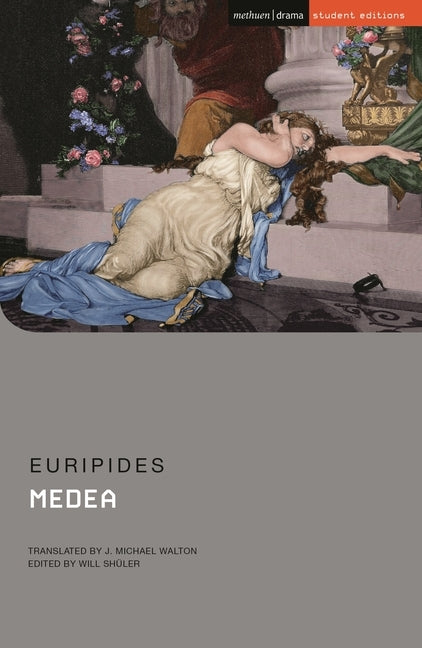
A Student Edition of Euripides' play, which accessibly unpacks Greek tragedy in its social context, issues of translation and adaptation, and performance approaches over the centuries.
Euripides' play Medea was first produced in 431BC and continues to be produced globally to this day. Its power and timeless appeal for audiences rests in its portrait of a woman driven to murder the new wife of the man who abandoned her and to murder her own children. In more recent times, Medea's actions have been taken as a symbol of female power in an otherwise male-dominated society. Will Shüler's commentary in this Student Edition looks at the violence of the play - both onstage and off; the original performance conditions; staging challenges, both then and now (including Medea's exit on a dragon); the notion of myth and how Greek tragedians were telling old stories to get new meanings; and how the play has evolved through translation. It considers a range of productions up to the present day, including the 2014 National Theatre production directed by Carrie Cracknell and starring Helen McCrory; Sophie Okonedo as Medea at the Soho Theatre, London, in 2023; and the 2000 Australian version, Black Medea, which interpreted Medea as an indigenous woman brought to a city by her ambitious husband.Euripides was born near Athens between 485 and 480 BC. His first play was presented in 455 BC and he wrote some 100 altogether of which nineteen survive - a greater number than those of Aeschylus and Sophocles combined - and which include Alkestis, Medea, Bacchae, Hippolytos, Ion and Iphigenia at Aulis. He died in 406 BC.
Will Shüler is Senior Lecturer in Drama and Theatre Studies at Royal Holloway, University of London, UK. His research and teaching focus on performance pedagogies, teaching and performance-making with new technologies, as well as Queer theatre and Greek tragedy.Thanks for subscribing!
This email has been registered!
Take 20% off your first order
Enter the code below at checkout to get 20% off your first order