





Before you leave...
Take 20% off your first order
20% off
Enter the code below at checkout to get 20% off your first order

Discover summer reading lists for all ages & interests!
Find Your Next Read
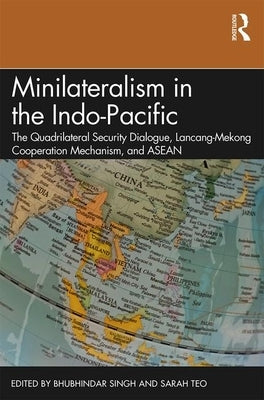
While US-centred bilateralism and ASEAN-led multilateralism have largely dominated the post-Cold War regional security architecture in the Indo-Pacific, increasing doubts about their effectiveness have resulted in countries turning to alternative forms of cooperation, such as minilateral arrangements. Compared to multilateral groupings, minilateral platforms are smaller in size, as well as more exclusive, flexible and functional.
Both China and the US have contributed to minilateral initiatives in the Indo-Pacific. In the case of the former, there is the Lancang-Mekong Cooperation mechanism--involving China, Cambodia, Laos, Myanmar, Thailand and Vietnam--established in 2015. In the case of the latter, there has been a revival of the Quadrilateral Security Dialogue in 2017--involving the US, Australia, Japan and India. This book examines the rise of these arrangements, their challenges and opportunities, as well as their impact on the extant regional security architecture, including on the ASEAN-led multilateral order.
A valuable guide for students and policy-makers looking to understand the nature and development of minilateralism in the Indo-Pacific region.
Bhubhindar Singh is Associate Professor, Coordinator of the Regional Security Architecture Programme, and Head of Graduate Studies at the S. Rajaratnam School of International Studies, Nanyang Technological University, Singapore.
Sarah Teo is Associate Research Fellow with the Regional Security Architecture Programme at the S. Rajaratnam School of International Studies, Nanyang Technological University, Singapore.
Thanks for subscribing!
This email has been registered!
Take 20% off your first order
Enter the code below at checkout to get 20% off your first order