
![Spider-Men: Worlds Collide [Marvel Premier Collection] by Bendis, Brian Michael](http://www.whiterainbookhouse.com/cdn/shop/files/img_2d0d0a87-9d07-4ffd-84f2-c4b241596800_533x.jpg?v=1762317878)




Before you leave...
Take 20% off your first order
20% off
Enter the code below at checkout to get 20% off your first order

Discover summer reading lists for all ages & interests!
Find Your Next Read
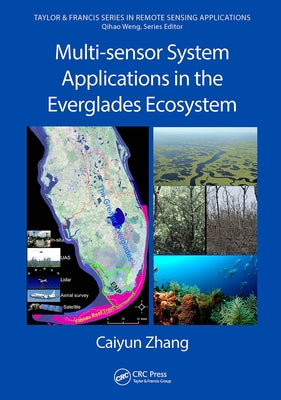
This book explores the applicability of multiple remote sensors to acquire information relevant to restoration and conservation efforts in wetlands using data collected from airborne and space multispectral/hyperspectral sensors, light detection and ranging (LiDAR), Unmanned Aircraft Systems (UAS), and a hand-held spectroradiometer. This book also examines digital data processing techniques such as object-based image analysis, machine learning, texture analysis, and data fusion. After an introduction to the Everglades and to remote sensing, the book is divided into four parts based on the sensor systems used. There are chapters on vegetation mapping, biomass and water quality modeling, applications of hyperspectral data for plant stress analysis and coral reef mapping, studies of airborne LiDAR data for coastal vulnerability analysis and DEM improvement, as well as chapters that explore a fusion of multiple sensors for different datasets.
Features
Multi-sensor System Applications in the Everglades Ecosystems provides a comprehensive application of remote sensing techniques in the Florida Everglades and its coastal ecosystems. It will prove an invaluable resource for the restoration and conservation of the Florida Everglades and beyond, for global wetlands in general. Any professional, scientist, engineer, or student working with remote sensing and wetland ecosystems will reap enormous benefits from this book.
Dr. Zhang received her Ph.D. in Geospatial Information Sciences from University of Texas, Dallas. Her research at FAU focuses on vegetation characterization in the Florida Everglades using multiple sensors, biomass modeling and mapping, water quality monitoring and mapping, and analyzing coastal vulnerability to sea level rise and hurricanes. She has developed innovative methodology frameworks to monitor and map the Greater Everglades by combining multiple sensors and GIS techniques, which can assist with the restoration and conservation of the Florida Everglades ecosystem. She applies modern machine learning and advanced remote sensing image processing techniques in the coastal environments to understand the effects of human activities and natural disasters on the modification of coastal landscapes. She is teaching five major remote sensing courses at FAU including Remote Sensing of Environment, Digital Image Analysis, Hyperspectral Remote Sensing, Lidar Remote Sensing and Applications, and Photogrammetry and Aerial Photo Interpretation.
Thanks for subscribing!
This email has been registered!
Take 20% off your first order
Enter the code below at checkout to get 20% off your first order