





Before you leave...
Take 20% off your first order
20% off
Enter the code below at checkout to get 20% off your first order

Discover summer reading lists for all ages & interests!
Find Your Next Read
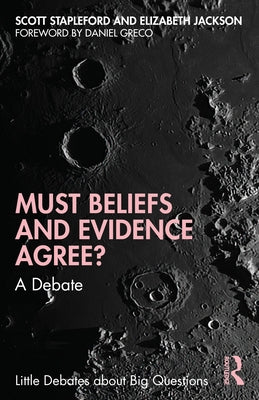
Should our beliefs be proportioned to our evidence? Are we doing something wrong in believing with little or no evidence? And may our beliefs be based partly or wholly on moral or practical considerations? These questions are harder than you think. Scott Stapleford and Elizabeth Jackson agree on the priority of evidence, but they differ on the degree of permissible slack and the relevance of other considerations.
In this lively epistemological debate, Stapleford takes a hard line, defending the extremist view that any discrepancy between what we believe and what our evidence supports is an error that should be corrected. In the economy of our beliefs, evidence alone has a normative grip. Jackson is more forgiving. While evidence regulates belief, its authority is not complete. She takes a more liberal perspective that accords non-evidential factors a lawful role in delimiting the class of permissible beliefs.
With echoes of the famous 19th century dispute between the mathematician William Clifford and the psychologist William James, the Stapleford-Jackson debate feels particularly relevant in a time when disagreement runs uncomfortably hot and evidence is treated with contempt. This debate will tempt--and gently instruct--anyone who has ever asked themselves: Can't I just believe what I want?
Key Features
Scott Stapleford is Professor of Philosophy at St. Thomas University in Fredericton, Canada. His recent publications include: Logic Works: A Rigorous Introduction to Formal Logic (with Lorne Falkenstein and Molly Kao, 2022), Hume's Enquiry: Expanded and Explained (with Tyron Goldschmidt, 2021), and six edited collections.
Elizabeth Jackson is an Associate Professor of Philosophy at Saint Louis University, and her research is in epistemology and philosophy of religion. She's published in journals such as Mind, Philosophy and Phenomenological Research, Australasian Journal of Philosophy, and Philosophical Studies.
Thanks for subscribing!
This email has been registered!
Take 20% off your first order
Enter the code below at checkout to get 20% off your first order