





Before you leave...
Take 20% off your first order
20% off
Enter the code below at checkout to get 20% off your first order

Discover summer reading lists for all ages & interests!
Find Your Next Read
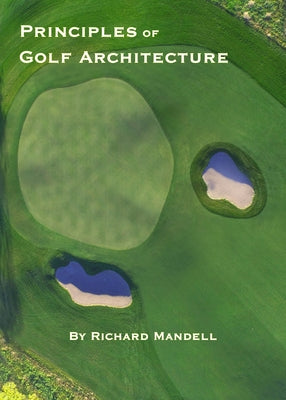
The Principles of Golf Architecture intends to describe the details of the golf course design process as concisely as possible, first by defining both the Elements and Principles of Design in general terms and then relating these concepts to the art and science of golf architecture.
Richard Mandell tackles the often ambiguous elements of Line, Form, Shape, and Texture, among others, and describes their application to the design of golf courses, from layout to details such as putting green design. In addition, he breaks down the universal principles of design such as Balance, Emphasis, Rhythm, and Variety and their utilization in golf architecture. Mandell brings his own principles to the process as well, such as Challenge, Chance, Mystery, Quirk, Randomness, and Subtlety.
Utilizing a multitude of course photos, sketches, and drawings to supplement the text, Mandell weaves together design theory, historical perspective, operational considerations, and construction practices to provide the reader with his perspective of what it takes to design and build a course from the golf architect's drawing table to fruition. Principles of Golf Architecture is a compendium of Mandell's forty years of experience, sharing his own thought process and design approach with the reader every step of the way.
Since Richard Mandell was fifteen years old, he has been captivated by the playing
fields of the game of golf. Growing up surrounded by some of the greatest golf
courses in the world, it was easy for him to fall under the spell. Winged Foot, National
Golf Links of America, Bethpage Black and many others in New York shaped his
early ideals and philosophies about the art of golf architecture.
Since those halcyon days of his youth, Richard Mandell, ASGCA, has gone on to
design more than 75 golf course projects of varying shapes and sizes in fifteen states
and China. His firm, Richard Mandell Golf Architecture, has earned 31 different
awards and accolades in four different decades of practice. In addition to being a
golf architect, he is a licensed landscape architect, certified arborist, and accomplished
writer. Richard is also a member of the USGA Museum Committee.
Principles of Golf Architecture is Mandell's fourth book. He has also written
numerous articles on golf architecture for magazines such as Golf Illustrated, Golf
Course Architecture Magazine, Golf Digest India, and Links Magazine and has
contributed chapters to four additional books on the subject: Volumes I and II of
Golf Architecture (A Worldwide Perspective), Links to St. Andrews, and Favourite
53 3
07
Simply put, scale compares the size of an object in relation to ourselves
and the world around us. Scale doesn't determine what is attractive or not but it will
elicit feelings of comfort or burden. The result is one's observation that an object
is either "in scale" or "out of scale" with its surroundings.
How one describes what is in scale or out of scale is a
subjective response based on personal feelings. In essence,
objects that are considered in scale just look or feel right.
When a reference is made to someone who has a "good
eye," the inference is that the person, among other traits,
can recognize objects which are in scale with each other
and/or their surroundings. It's much easier to describe how
something is out of scale. When an object is out of scale
with the objects near it, that object is too big or too small in
relation to the size of those objects. The object doesn't fit
our established frame of reference.
There are three generally-accepted terms for
denoting the Element of Scale: Human Scale, Monumental
Scale, and Shock Scale. All three scale types utilize the human
form for distinction. Human Scale is used to design things
for the physical and cognitive characteristics of humans. In
other words, things are designed - whether they are spaces,
vehicles, tools, or computers - so they can be understood and
utilized at a level that relates to the limitations of a person.
Human Scale balances the size of a space or object
with the size of the user/viewer, allowing the user to feel
comfortable more than anything else. Human Scale allows
the users to feel themselves in agreeable proportion to what
they see and hear so they share a sense of being related
to the environment in a pleasing way. When comfort and
assurance are desirable traits in a design process, Human
Scale must be made evident.
Scale - The size of an object relative to the size of the space
in which it is located or other objects within that space.
The Element of Scale
Human Scale
(Courtesy: Patrick Gainer)
Monumental Scale
(Courtesy: Patrick Gainer)
Shock Scale
(Courtesy: Patrick Gainer)
Holes By Design: The Architect's Choice. His 2007 book, Pinehurst Home of
American Golf (The Evolution of a Legend) won the 2008 International Network of
Golf Book of the Year and was a finalist for the USGA Herbert Warren Wind Award
as well as a ForeWord Magazine Sports Book Award 2007 Finalist.
Thanks for subscribing!
This email has been registered!
Take 20% off your first order
Enter the code below at checkout to get 20% off your first order