





Before you leave...
Take 20% off your first order
20% off
Enter the code below at checkout to get 20% off your first order

Discover summer reading lists for all ages & interests!
Find Your Next Read
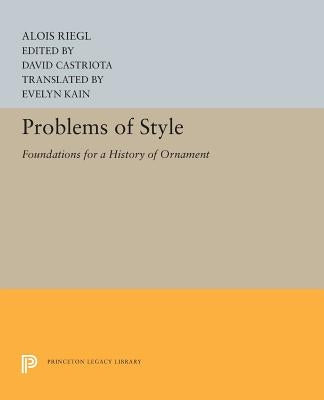
Written at the height of the arts and crafts movement in fin-de-siecle Vienna, Alois Riegl's Stilfragen represented a turning point in defining art and understanding the sources of its inspiration. Demonstrating an uninterrupted continunity in the history of ornament from the ancient Egyptian through the Islamic period, Riegl argued that the creative urge manifests itself in both "great art" and the most humble artifact, and that change is an inherent part of style. This new translation, which renders Riegl's seminal work in contemporary, readable prose, allows for a fresh reexamination of his thought in light of current revisionist debate.
His discovery of infinite variation in the restatement of several decorative motifs--the palmette, rosette, tendril--led Riegl to believe that art is completely independent from exterior conditions and is beyond individual volition. This thinking laid the groundwork for his famous concept of Kunstwollen, or artistic intention.
"Something that the translation will, I hope, convey, is the passion invsted in Riegl's enterprise. We are made to feel that the issues he discussed mattered vitally to him; it was the very nature of art and its relation to human life that were at stake, art as an absolute necessity." --From the preface of Henri Zerner
Alois Reigl (1858-1905) was Curator of Textiles at the Museum of Art and Industry in Vienna during most of his career and wrote many influential works on the history of art, including Spatromische Kunstgeschichte. Evelyn Kain is Associate Professor of Art History at Ripon College, Ripon, Wisconsin. David Castriota is Assistant Professor of Art History at Sarah Lawrence College.
Thanks for subscribing!
This email has been registered!
Take 20% off your first order
Enter the code below at checkout to get 20% off your first order