




Before you leave...
Take 20% off your first order
20% off
Enter the code below at checkout to get 20% off your first order

Discover summer reading lists for all ages & interests!
Find Your Next Read
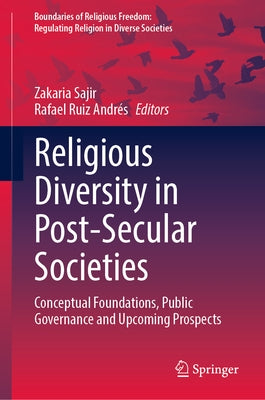
This book offers a multidisciplinary exploration of one of the defining characteristics of post-secular societies: religious diversity. Drawing from the sociology of religion, the sociology of migration, and related fields, it critically examines the interaction between religion, diversity, and secular governance, challenging conventional approaches to managing pluralism in contemporary contexts.
Organized into three sections, the book explores:
Featuring contributions from leading scholars and emerging researchers, this volume provides a multidimensional perspective on debates spanning sociology, anthropology, law, and public policy. Through socio-historical examples and case studies, it examines pressing topics such as religious pluralism in secular governance, diversity management strategies, and the transformative impact of digital technologies on religious expression.
At its core, the book is framed by two key concepts: post-secularization and diversity. It reexamines religion's evolving role in secularized societies, taking religious plurality--not the disappearance of religion--as a starting point for exploring secularity. This work is an essential resource for students, researchers, educators, policymakers, and professionals seeking actionable insights into critical debates on religion, migration, diversity, and secular governance in today's globalized and digitalized world.
Zakaria Sajir is a Lecturer in the Department of Sociology and Communication at the University of Salamanca. Previously, he was a Juan de la Cierva Postdoctoral Fellow at the Institute of Economics, Geography, and Demography at the Spanish National Research Council (CSIC) (2021-2023). Holding a PhD in Sociology from the University of Leicester (2018), a Laurea Specialistica in European and International Studies from the University of Trento (2011), and a Laurea Triennale in Sociology from the University of Milan-Bicocca (2007), his research focuses on migration, ethnic and religious diversity, discrimination, and radicalization. His work has been published in leading journals such as the Journal of Ethnic and Migration Studies (JEMS), Religions, and the International Journal of Communication. Dr. Sajir has contributed to multiple international research projects, including Voices of African Migrants (Ford Foundation), Minority Women's Activism in Tough Times (British Academy), and Pathways to Power (ESRC). From 2016 to 2021, he was an active member of the COST Action Ethnic and Migrant Minorities' Survey Data Network, where he served as a substitute member of the Management Committee for the UK and a delegate for the subnational working group. This initiative received the Open Science - Open Data Award from the French Ministry of Higher Education and Research in 2022.
Rafael Ruiz Andrés is a Lecturer in the Department of Applied Sociology at the Complutense University of Madrid. He holds a PhD in Religious Studies (2019) with a research on the process of secularisation in Spain, which was awarded the Complutense Extraordinary Doctoral Prize and the Prize for the Best Doctoral Thesis in Religious Studies in Spain. He is the editor of the indexed journal 'Ilu. Revista de Ciencias de las Religiones. Throughout his career, he has been a fellow of the Europaeum Scholarship Programme, coordinated by the University of Oxford (2018-2019), and has carried out research stays at the École Pratique des Hautes Études (Paris) and at University College London. He is a visiting professor at La Sapienza University of Rome. His research focuses on the sociology of religion, especially (post)secularisation, non-religion, religious pluralism, and intercultural and interreligious dialogue. He has published more than forty academic works, including articles in leading journals such as the Journal of Contemporary Religion, Revista Española de Investigaciones Sociológicas (REIS) and Sociology Lens, and the book La secularización en España (2022, Cátedra).
Thanks for subscribing!
This email has been registered!
Take 20% off your first order
Enter the code below at checkout to get 20% off your first order