





Before you leave...
Take 20% off your first order
20% off
Enter the code below at checkout to get 20% off your first order

Discover summer reading lists for all ages & interests!
Find Your Next Read
Chapter 1. Methods of flight safety risk management
1.1. Methods based on the model of aviation "event tree" development
1.1.1. Main provisions. Methodology of event type list forming
1.1.2. "Tree" formation and principles of basic probabilities evaluation
1.1.2.1. Methodology of "tree" design
1.1.2.2. Methods for evaluation of emergency factors basic probabilities
1.1.3. Basic probabilities evaluation for the group "Environment"1.1.3.1. Structure of group accountable factors
1.1.3.2. Basic probabilities evaluation for the natural environment factors
1.1.3.3. Methodology for the runway performances treatment1.1.3.4. Methodology for aerodrome infrastructure drawbacks treatment
1.1.4. Method of a posteriori probabilities adjustment
1.1.4.1. Formulation of the problem. Implementation of fuzzy estimations for a priori event probability distribution forming
1.1.4.2. Forming of a posteriori event probability distribution
1.1.5. Implementation of the method in automated system of forecasting and prevention of aviation accidents
1.2. Method of flight safety risk management using conditional factors and fuzzy evaluations
1.2.1. Formulation of the problem and approach to the solution. Content and structure of the source data
1.2.2. Severity factor and method of its calculation
1.2.3. Admissibility factor and method of its calculation
1.2.3.1. Rationale for fuzzy evaluation applicability
1.2.3.2. Composition of membership functions and the system of fuzzy logic conclusion1.2.4. Implementation of the method in automated risk management system
1.3. Method of flight safety risk management based on the three-cocmponent model
1.3.1 Formulation of the problem. Algorithm of divergence and event risk index evaluation
1.3.2. Algorithm of emergency risk evaluation
Chapter 2. Aircraft overrun risk reducing methods
2.1. Description of aircraft runway movement after landing2.2. Analysis of the problem of information supply on runway surface conditions
2.3. Methods of the crew situational raise awareness about runway conditions
2.3.1. Institutional arrangements and improvement of interpretation methods for descriptive information
2.3.2. Experimental detection of correlation dependence between Canadian and Russian runway friction indices.
2.4. Overrun risk management method based on statistical modeling.
2.4.1. Development of mathematical model for aircraft runway movement and its implementation in the program "Overrun Probability"
2.4.2. Joint application of the program "Overrun Probability" and multidimensional statistical methods of data analysis
2.4.2.1. Research objectives. Primary data processing
2.4.2.2. Principle component analysis method for comprehensive analysis of landing data
2.5. Overrun prognostication
2.5.1. Modification of "Overrun Probability"program mathematical model for prognostication task
2.5.2. Overrun prognosticating algorithm development for aborted take-off
Chapter 3. Practices to combat external impact on the aircraft navigation systems in civil aviation and flight regulatory management
3.1.
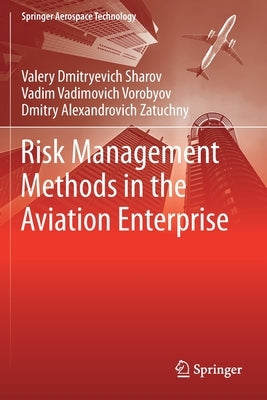
Author: Valery Dmitryevich Sharov, Vadim Vadimovich Vorobyov, Dmitry Alexandrovich Zatuchny
ISBN-10: 9813360194
ISBN-13: 9789813360198
Publisher: Springer
Language: English
Published: 04/14/2022
Pages: 214
Format: Paperback
Weight: 0.72lbs
Size: 9.21h x 6.14w x 0.48d
Valery Dmitryevich Sharov is Doctor of technical science, currently Professor of the Department of Flight and Life Safety at the Moscow State Technical University of Civil Aviation. He is the author of more than 100 scientific works on air navigation and flight safety, including 2 monographs. His research interests are in the area of flight safety management systems.
Vadim Vadimovich Vorobyov is Professor, Doctor of technical science, currently the Head of the Department of Flight and Life Safety at the Moscow State Technical University of Civil Aviation. His research interests are in the area of improvement of flight safety management systems.Dmitry Alexandrovich Zatuchny is Associated Professor, Doctor of technical science and Professor at the Department of Computation Machines, Complexes, Systems and Networks at Moscow State TechnicalUniversity of Civil Aviation. He is the author of more than 140 scientific works, including 5 monographs, 6 textbooks, 1 patent on invention and 6 state registered computer programs. He was responsible for a number of research projects on ensuring the functioning of modern navigation systems in civil aviation aircraft and air traffic control.
Thanks for subscribing!
This email has been registered!
Take 20% off your first order
Enter the code below at checkout to get 20% off your first order