





Before you leave...
Take 20% off your first order
20% off
Enter the code below at checkout to get 20% off your first order

Discover summer reading lists for all ages & interests!
Find Your Next Read
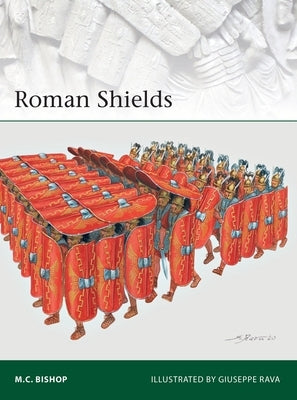
The Roman shield, the scutum, was central to the Romans' conquest of the known world, and has become an emblem of the legions at the forefront of that effort. This new study draws on the latest research to reveal the history of this iconic equipment.
The introduction of the scutum in the 4th century BC revolutionized the way the Romans fought. Instead of being purely defensive, the shield became a weapon in its own right. Using the top edge or boss to punch an opponent, or the lower rim to smash down on their feet, it served to unbalance an enemy and allow the sword to do its work. The versatility of the scutum was characterized by the testudo, a formation the Romans used offensively like a pedestrian tank. Meanwhile, other shield types equipped the auxiliaries who fought alongside the legionaries. The curved, rectangular scutum survived into the 3rd century AD, only to be replaced by an oval, slightly domed shield derived from the oval shields of Early Imperial auxiliaries. Drawing together historical accounts, excavated artifacts, and the results of the latest scientific analyses of the boards and fittings, renowned authority M.C. Bishop reveals the development, technology, training, and use of the scutum and other Roman shield types.Writer, publisher, and archaeologist M.C. Bishop is an authority of all aspects of Ancient Rome at war, with particular emphasis on arms and armor of the era. He has written, co-written, or edited dozens of books and articles on the subject, including volumes on the gladius and pilum for the Osprey Weapons series, and leads tours of Hadrian's Wall and other Roman sites.
Giuseppe Rava was born in Faenza in 1963, and took an interest in all things military from an early age. Entirely self-taught, Giuseppe has established himself as a leading military history artist and is inspired by the works of the great military artists, such as Detaille, Meissonier, Rhling, Lady Butler, Ottenfeld, and Angus McBride. He lives and works in Italy.Thanks for subscribing!
This email has been registered!
Take 20% off your first order
Enter the code below at checkout to get 20% off your first order