





Before you leave...
Take 20% off your first order
20% off
Enter the code below at checkout to get 20% off your first order

Discover summer reading lists for all ages & interests!
Find Your Next Read
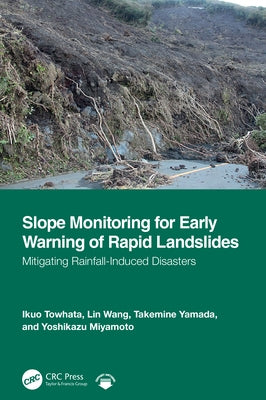
The coauthors of this book draw on their decades of research and innovation to describe an inexpensive and easy-to-interpret early warning system for rainfall-induced landslides. This system will enable readers to identify slope collapses before they happen and act to prevent economic and human losses.
Readers will gain an understanding of existing slope monitoring technologies and their applications, advantages and disadvantages. They will also understand the need for early warning systems for rapid landslides caused by heavy rainfall. Because such landslides are increasing in frequency due to climate-change-related increase in short-term but heavy rainfall, the authors first review the current context before explaining the importance of field monitoring for their continuing professional career development. The authors describe their technology, which is based on an inexpensive tiltmeter sensor and can detect landslides several hours prior to their onset. It is important that the authors present ample cases in which their technology could foresee imminent landslides. This description is supported by in-depth comparisons with other methodologies, field tests and case studies. Finally, existing problems are introduced and future research directions are presented. This information will enable readers to implement their own systems to identify slopes at imminent risk of collapse following rainfall events so that they may take appropriate action to prevent economic damage and loss of life.
Slope Monitoring for Early Warning of Rapid Landslides: Mitigating Rainfall-Induced Disasters is an indispensable guide for practitioners in both public and private sectors who are responsible for the implementation of slope monitoring and landslide early warning systems. Postgraduate students who specialize in the mitigation of natural disasters and the effects of global climate change will also benefit from the discussions of differing available technologies and case studies.
Ikuo Towhata is Professor Emeritus at The University of Tokyo. He was formerly President of the Japanese Geotechnical Society and Vice President for Asia of the International Society for Soil Mechanics and Geotechnical Engineering (ISSMGE). He obtained his PhD from the University of Tokyo in 1982.
Lin Wang is a Senior Engineer at Chuo-Kaihatsu Inc., Tokyo and Visiting Professor at Sichuan University. He is a member of the ISSMGE's Technical Committee 220 for Field Monitoring of ISSMGE. He received his PhD from The University of Tokyo.
Takemine Yamada is a Senior Research Engineer at Kajima Technical Research Institute, Tokyo. He is a member of the ISSMGE's Technical Committee 221 for Tailings and Mine Wastes of ISSMGE. He received his PhD from The University of Tokyo.
Yoshikazu Miyamoto is a professor of Department of the Social Management Engineering, Faculty of Engineering, Tottori University in Japan. He is a member of the Committee on Global Environment in Japan, Society of Civil Engineers. He received his PhD from the Tottori University.
Thanks for subscribing!
This email has been registered!
Take 20% off your first order
Enter the code below at checkout to get 20% off your first order