





Before you leave...
Take 20% off your first order
20% off
Enter the code below at checkout to get 20% off your first order

Discover summer reading lists for all ages & interests!
Find Your Next Read
- Abstract
- People, places and acts of crime
o The problematic dichotomy of criminology
o Aggregations of crime and acts of crime: The problematic level of explanation
o The problematic dichotomised study of crime events
o Why integrate people and places to explain action?
- Person-environment integration: How?
o The additive and interactive worldviews
o Approaches to criminological research
o Interaction, explanation, prevention
- Summary: Advocating an analytic criminology of person-environment interaction in acts of crime for effective prevention
- References
Chapter 2: Integrating individuals and environments: A Situational approach to studying action- Abstract
- Lacking an integrative model of action
- Studying dependency
- Integrative models of acts of crime
o Situational Action Theory and the situational model
o 'Situation', 'environment' and 'setting'
- Studying convergence: New approach, new methods
o Exposure
o Summary
- Appendix: Clarity of definitions and concepts: 'situation', 'environment' and 'setting'
o Conceptual ambiguity in psychology
o Conceptual conflation in criminology
o 'Situation' in criminology: Historical context of a misnomer
- References
Chapter 3: Evidencing situational interaction without situation-level exposure data- Abstract
- Making do without situation-level exposure data
- Interaction (dependence) in regression models
- Solving the problematic distribution of crime
o Non-linear models
o Transformation of the dependent variable
o OLS regression plus safeguards
- Reliability and interpretation
o Significance
o Comparing groups to access meaning
- Conclusion- References
Chapter 4: Collecting and analysing situation-level exposure data: Clarifying appropriate analysis of the convergence of people in environments to explain action- Abstract
- Designing situational research- Collecting situation-level exposure data
o Space-Time Budgets
o Randomised Scenarios
o Future methodological avenues
- Analysing situation-level exposure datao Additive Analysis
o Situational Analysis
o Evaluating approaches to
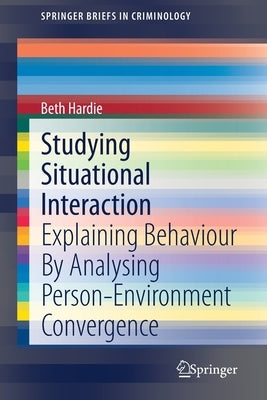
Author: Beth Hardie
ISBN-10: 3030461939
ISBN-13: 9783030461935
Publisher: Springer
Language: English
Published: 07/02/2020
Pages: 106
Format: Paperback
Weight: 0.41lbs
Size: 9.21h x 6.14w x 0.26d
Dr. Beth Hardie is a Research Associate at the Institute of Criminology, a member of the Centre for Analytic Criminology, and Research Manager of the Peterborough Adolescent and Young Adult Development Study (PADS+) at the University of Cambridge. Her work is grounded in an analytical approach (guided by Situational Action Theory; SAT) that integrates individually and environmentally focused explanations of human behaviour, including crime. She has a particular and critical interest in the data collection and analytical methodology required for the analysis of situational interaction (the interaction between people and settings) in action.
Thanks for subscribing!
This email has been registered!
Take 20% off your first order
Enter the code below at checkout to get 20% off your first order