
![Spider-Men: Worlds Collide [Marvel Premier Collection] by Bendis, Brian Michael](http://www.whiterainbookhouse.com/cdn/shop/files/img_2d0d0a87-9d07-4ffd-84f2-c4b241596800_533x.jpg?v=1762317878)




Before you leave...
Take 20% off your first order
20% off
Enter the code below at checkout to get 20% off your first order

Discover summer reading lists for all ages & interests!
Find Your Next Read
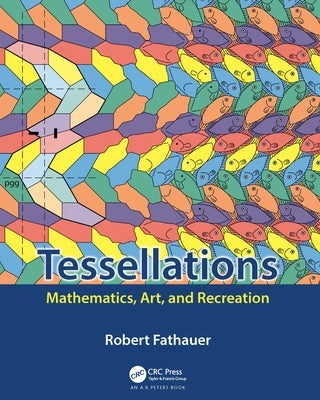
Tessellations: Mathematics, Art and Recreation aims to present a comprehensive introduction to tessellations (tiling) at a level accessible to non-specialists. Additionally, it covers techniques, tips, and templates to facilitate the creation of mathematical art based on tessellations. Inclusion of special topics like spiral tilings and tessellation metamorphoses allows the reader to explore beautiful and entertaining math and art.
The book has a particular focus on 'Escheresque' designs, in which the individual tiles are recognizable real-world motifs. These are extremely popular with students and math hobbyists but are typically very challenging to execute. Techniques demonstrated in the book are aimed at making these designs more achievable. Going beyond planar designs, the book contains numerous nets of polyhedra and templates for applying Escheresque designs to them.
Activities and worksheets are spread throughout the book, and examples of real-world tessellations are also provided.
Key features
Robert Fathauer has had a life-long interest in art but studied physics and mathematics in college, going on to earn a PhD from Cornell University in electrical engineering. For several years he was a researcher at the Jet Propulsion Laboratory in Pasadena, California. Long a fan of M.C. Escher, he began designing his own tessellations with lifelike motifs in the late 1980s. In 1993, he founded a business, Tessellations, to produce puzzles based on his designs. Over time, Tessellations has grown to include mathematics manipulatives, polyhedral dice, and books.
Dr. Fathauer's mathematical art has always been coupled with recreational math explorations. These include Escheresque tessellations, fractal tilings, and iterated knots. After many years of creating two-dimensional art, he has recently been building ceramic sculptures inspired by both mathematics and biological forms. Another interest of his is photographing mathematics in natural and synthetic objects, particularly tessellations. In addition to creating mathematical art, he's strongly committed to promoting it through group exhibitions at both the Bridges Conference and the Joint Mathematics Meetings.
Thanks for subscribing!
This email has been registered!
Take 20% off your first order
Enter the code below at checkout to get 20% off your first order