




Before you leave...
Take 20% off your first order
20% off
Enter the code below at checkout to get 20% off your first order

Discover summer reading lists for all ages & interests!
Find Your Next Read
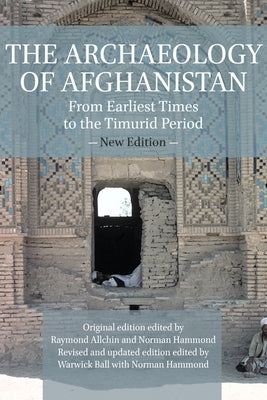
Afghanistan is at the cultural crossroads of Asia, where the great civilisations of Mesopotamia and Iran, South Asia and Central Asia overlapped and sometimes conflicted. Its landscape embraces environments from the high mountains of the Hindu Kush to the Oxus basin and the great deserts of Sistan; trade routes from China to the Mediterranean, and from Central Asia to the Arabian Sea cross the country. It has seen the development of early agriculture, the spread of Bronze Age civilisation of Central Asia, the conquests of the Persians and of Alexander of Macedon, the spread of Buddhism and then Islam, and the empires of the Kushans, Ghaznavids, Ghurids and Timurids centred there, with ramifications across southern Asia. All of which has resulted in some of the most important, diverse and spectacular historical remains in Asia.
First published in 1978, this was the first book in English to provide a complete survey of the immensely rich archaeological remains of Afghanistan. The contributors, all acknowledged scholars in their field, have worked in the country, on projects ranging from prehistoric surveys to the study of Islamic architecture. It has now been thoroughly revised and brought up to date to incorporate the latest discoveries and research.
Raymond Allchin (1923-2010) was at the Faculty of Oriental Studies, University of Cambridge, and one of the foremost British archaeologists in South Asian archaeology.
Warwick Ball is a Near Eastern archaeologist and author who spent over twenty years carrying out excavations, architectural studies and monumental restoration throughout the Middle East and adjacent regions. Over the past fifty years he has lived, worked and travelled in most countries between Europe and China covered by this book, in particular in remote parts of Inner Asia. He has excavated in Iran, Libya, Ethiopia, Afghanistan (where he was Acting Director of the British Institute of Afghan Studies), Jordan, and Iraq (where he was Director of Excavations with the British School of Archaeology in Iraq). For five years he was founder, editor and Editor-in-Chief of Afghanistan, the journal of the American Institute of Afghanistan Studies published by Edinburgh University Press. He has written widely on the history and archaeology of the region, including Syria: An Architectural and Historical Guide (3rd edition 2006) and The Monuments of Afghanistan: History, Archaeology, Architecture (2008). Two major academic books, the Archaeological Gazetteer of Afghanistan (Oxford University Press) and The Archaeology of Afghanistan (Edinburgh University Press) were published in 2019. In 2020, the University of St Andrews confirmed they would be offering the honorary degree of Doctor of Letters on the author in recognition of his work in Near Eastern archaeology.
Professor Norman Hammond is a Senior Fellow at the McDonald Institute for Archaeological Research at Cambridge University. He was founding editor of South Asian Archaeology and of Afghan Studies.
Thanks for subscribing!
This email has been registered!
Take 20% off your first order
Enter the code below at checkout to get 20% off your first order