




Before you leave...
Take 20% off your first order
20% off
Enter the code below at checkout to get 20% off your first order

Discover summer reading lists for all ages & interests!
Find Your Next Read
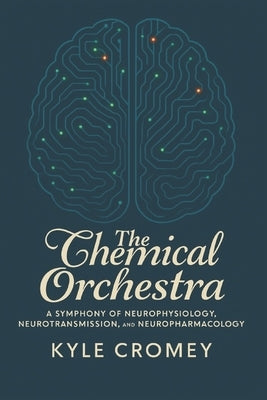
A Symphony of Neurophysiology, Neurotransmission, and Neuropharmacology
By Kyle Cromey
What if the brain is not a machine to be fixed, but an orchestra to be understood?
In The Chemical Orchestra, clinical pharmacist and digital health leader Kyle Cromey offers a bold, unifying way to understand how the brain truly works. Drawing on neuroscience, pharmacology, and systems thinking, this book reframes brain function as a living symphony, one in which electricity sets the tempo, chemistry gives voice, and drugs act not as controllers, but as conductors.
Rather than treating neurophysiology, neurotransmitters, and neuropharmacology as isolated topics, The Chemical Orchestra weaves them together into a single, coherent narrative. Neurons do not fire in isolation. Neurotransmitters do not act alone. Drugs do not "switch" the brain on or off. Meaning, behaviour, and experience emerge from coordination, balance, timing, and adaptation.
This book is structured in three movements:
Movement I - Neurophysiology
The electrical foundations of thought: membrane potentials, ion channels, synapses, excitation and inhibition, plasticity, and neural circuits. This movement establishes the rules of the system, how signals become meaningful.
Movement II - Neurotransmitters
The instruments of the orchestra: glutamate and GABA, acetylcholine, dopamine, serotonin, noradrenaline, histamine, adenosine, endocannabinoids, neuropeptides, and atypical messengers. Each is explored not as a chemical in isolation, but as a role within a wider network.
Movement III - Neuropharmacology
The conductor's influence: how drugs shape probability, bias networks, and alter states without ever fully controlling the music. From fast and slow drugs, to adaptation, tolerance, balance, breakdown, and personalisation, this movement explains why pharmacology is powerful, and why it must be used with humility.
Throughout the book, complex ideas are made accessible without being simplified. Clinical realities such as depression, psychosis, epilepsy, and addiction are explored as disorders of orchestration rather than "chemical imbalances." Ancient remedies and modern medicines are shown to share the same underlying principles, even as the language has changed.
The Chemical Orchestra is not a textbook, and it is not pop science. It is a systems-level synthesis for readers who want to truly understand the brain, clinicians, students, scientists, and intellectually curious readers alike.
If you have ever wondered why:
one drug helps one person but harms another
side effects coexist with benefits
brain disorders resist simple explanations
pharmacology works best when it listens rather than commands
Then this book is for you.
The brain is always playing.
The question is whether we are listening.
Thanks for subscribing!
This email has been registered!
Take 20% off your first order
Enter the code below at checkout to get 20% off your first order