





Before you leave...
Take 20% off your first order
20% off
Enter the code below at checkout to get 20% off your first order

Discover summer reading lists for all ages & interests!
Find Your Next Read
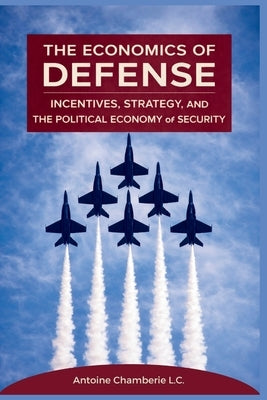
Here is a serious, academically positioned, conversion-optimized KDP description for:
The Economics of Defense: Incentives, Strategy, and the Political Economy of SecurityNational defense is often described as priceless. In reality, it is one of the most expensive, complex, and structurally constrained economic systems in the modern world.
Global military expenditure now exceeds $2 trillion annually. Nations devote between 1-6% of GDP to defense. Alliances struggle with burden sharing. Arms races escalate through rational decisions that generate collectively suboptimal outcomes. Procurement costs expand beyond projections. War debt reshapes generations.
Yet public debates about defense are typically framed in moral or strategic language - not economic structure.
The Economics of Defense provides a rigorous, analytical framework for understanding how security systems actually function.
Grounded in public goods theory, game theory, public finance, industrial organization, and international political economy, this book examines:
Why defense cannot be efficiently provided by markets
How the free rider problem distorts alliances
Why the security dilemma produces predictable escalation
The economic logic behind arms races
The guns-versus-butter tradeoff and opportunity cost
War finance and long-run debt sustainability
Defense procurement and principal-agent failures
Military R&D spillovers into civilian innovation
Geoeconomics, sanctions, and strategic supply chains
The hidden externalities of security systems
Rather than treating defense as ideology or rhetoric, this book models it as a structured system of incentives.
Through formal frameworks, empirical data, and institutional analysis, it demonstrates that many outcomes in national security - cost overruns, alliance tensions, escalation cycles, technological spillovers - are not accidental. They are economically predictable.
This is not a partisan argument.
It is not a military memoir.
It is not a polemic.
It is a systematic examination of how incentives, strategy, and political institutions shape the economics of security.
Designed for graduate students, policy analysts, defense professionals, researchers, and readers of international political economy, this volume provides the conceptual tools needed to evaluate military spending, alliance design, and strategic competition with clarity rather than confusion.
Security is not beyond analysis.
It is structured.
It is measurable.
And it can be understood.
The answers are within reach - and they are grounded in economic reasoning.
Thanks for subscribing!
This email has been registered!
Take 20% off your first order
Enter the code below at checkout to get 20% off your first order