
![Spider-Men: Worlds Collide [Marvel Premier Collection] by Bendis, Brian Michael](http://www.whiterainbookhouse.com/cdn/shop/files/img_2d0d0a87-9d07-4ffd-84f2-c4b241596800_533x.jpg?v=1762317878)




Before you leave...
Take 20% off your first order
20% off
Enter the code below at checkout to get 20% off your first order

Discover summer reading lists for all ages & interests!
Find Your Next Read
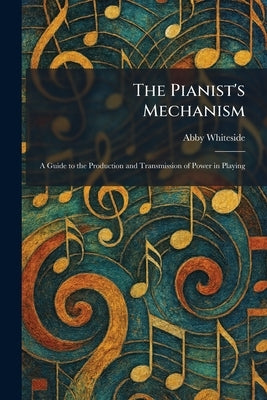
"The Pianist's Mechanism: A Guide to the Production and Transmission of Power in Playing" is a seminal treatise on the physical and artistic foundations of piano performance. Written by the influential pedagogue Abby Whiteside, this work challenges traditional finger-centric approaches to the keyboard, advocating instead for a holistic method rooted in the body's natural coordination. Whiteside explores the intricate relationship between physical movement and musical expression, emphasizing the role of the rhythm of the whole body in achieving technical mastery and tonal beauty.
The text delves into the mechanics of power transmission from the larger muscle groups to the fingertips, offering detailed insights into how a pianist can develop a fluid, effortless technique. By focusing on the interplay of weight, leverage, and rhythm, Whiteside provides a comprehensive framework for overcoming physical tension and technical hurdles. Her revolutionary ideas on horizontal musical thinking and the internal rhythmic pulse continue to resonate with students and professionals alike.
This guide remains an essential resource for those seeking to understand the physiological basis of piano playing. It offers timeless wisdom for pianists, teachers, and musicologists interested in the evolution of modern keyboard pedagogy and the pursuit of a more expressive and physically sustainable performance style.
This work has been selected by scholars as being culturally important, and is part of the knowledge base of civilization as we know it. This work was reproduced from the original artifact, and remains as true to the original work as possible. Therefore, you may see the original copyright references, library stamps (as most of these works have been housed in our most important libraries around the world), and other notations in the work.
This work is in the public domain in the United States of America, and possibly other nations. Within the United States, you may freely copy and distribute this work, as no entity (individual or corporate) has a copyright on the body of the work.
As a reproduction of a historical artifact, this work may contain missing or blurred pages, poor pictures, errant marks, etc. Scholars believe, and we concur, that this work is important enough to be preserved, reproduced, and made generally available to the public. We appreciate your support of the preservation process, and thank you for being an important part of keeping this knowledge alive and relevant.
Thanks for subscribing!
This email has been registered!
Take 20% off your first order
Enter the code below at checkout to get 20% off your first order