





Before you leave...
Take 20% off your first order
20% off
Enter the code below at checkout to get 20% off your first order

Discover summer reading lists for all ages & interests!
Find Your Next Read
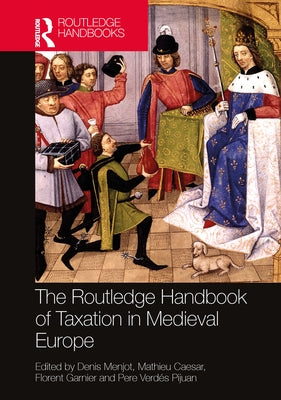
Beginning in the twelfth century, taxation increasingly became an essential component of medieval society in most parts of Europe. The state-building process and relations between princes and their subject cities or between citizens and their rulers were deeply shaped by fiscal practices. Although medieval taxation has produced many publications over the past decades there remains no synthesis of this important subject.
This volume provides a comprehensive overview on a European scale and suggests new paths of inquiry. It examines the fiscal systems and practices of medieval Europe, including essential themes such as medieval fiscal theory and the power to tax; royal and urban taxation; and Church taxation. It goes on to survey the entire European continent, as well as including comparative chapters on the non-European medieval world, exploring questions on how taxation developed and functioned; what kinds of problems authorities encountered assessing their fiscal power; and the circulation of fiscal cultures and practices across cities and kingdoms. The book also provides a glossary of the most important types of medieval taxes, giving an essential definition of key terms cited in the chapters.
The Routledge Handbook of Public Taxation in Medieval Europe will appeal to a large audience, from seasoned scholars who need a comprehensive synthesis, to students and younger scholars in search of an overview of this critical subject.
Denis Menjot is Emeritus Professor of Medieval History at the Universit? Lumi?re-Lyon 2. With Pere Verd?s Pijuan he directs the e-Glossary of Medieval Taxation. He has been president of the European Association of Urban History (2006-2008). He is president of the Soci?t? Fran?aise d'Histoire Urbaine, director of Histoire Urbaine and corresponding member of the Real Academia de la Historia. His previous publications include "Taxation and Sovereignty in Medieval Castile", in Authority and Spectacle in Medieval and Early Modern Europe, Routledge, 2017.
Mathieu Caesar is Associate Professor in Medieval History at the Universit? de Gen?ve. He is the author of Le pouvoir en ville. Gestion urbaine et pratiques politiques ? Gen?ve (fin XIIIe - d?but XVIe si?cles), Brepols, 2011, and the editor of Factional Struggles. Divided Elites in European Cities and Courts (1400-1750), Brill, 2017, and (with Franco Morenzoni), La Loi du Prince, vol. 1: Les Statuts de Savoie d'Am?d?e VIII (1430), Turin, 2019.
Florent Garnier is Professor in Legal History at the University of Toulouse 1 Capitole. He is member of Commission scientifique du Comit? pour l'Histoire Economique et Financi?re de la France. His previous publications include "Le fort portant le faible", D?clarez vos revenus! Histoire et imaginaire d'un instrument fiscal (XVIIIe-XXIe si?cle), O. Poncet et K. Weidenfeld (?tudes r?unies par), Collection "?tudes et rencontres de l'?cole des Chartes", 57, Paris, 2019.
Pere Verd?s Pijuan is currently Senior Scientist in the IMF-CSIC in Barcelona, Spain, where he directs the research group on "Taxation and public finances in the Crown of Aragon (13th-15th centuries)". He is director with Denis Menjot of the Glossary of Medieval Taxation and is part of the Steering Committee of the research network on taxation in the Hispanic kingdoms Arca Comunis. Since 2019, he has been director of the Anuario de Estudios Medievales.
Thanks for subscribing!
This email has been registered!
Take 20% off your first order
Enter the code below at checkout to get 20% off your first order