




Before you leave...
Take 20% off your first order
20% off
Enter the code below at checkout to get 20% off your first order

Discover summer reading lists for all ages & interests!
Find Your Next Read
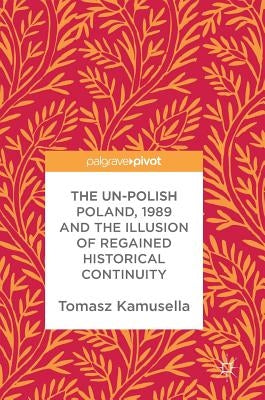
This book discusses historical continuities and discontinuities between the Polish-Lithuanian Commonwealth, interwar Poland, the Polish People's Republic, and contemporary Poland. The year 1989 is seen as a clear point-break that allowed the Poles and their country to regain a 'natural historical continuity' with the 'Second Republic, ' as interwar Poland is commonly referred to in the current Polish national master narrative. In this pattern of thinking about the past, Poland-Lithuania (nowadays roughly coterminous with Belarus, Latvia, Lithuania, Poland, Russia's Kaliningrad Region and Ukraine) is seen as the 'First Republic.' However, in spite of this 'politics of memory' (Geschichtspolitik) - regarding its borders, institutions, law, language, or ethnic and social makeup - present-day Poland, in reality, is the direct successor to and the continuation of communist Poland. Ironically, today's Poland is very different, in all the aforementioned aspects, from the First and Second Republics. Hence, contemporary Poland is quite un-Polish, indeed, from the perspective of Polishness defined as a historical (that is, legal, social, cultural, ethnic and political) continuity of Poland-Lithuania and interwar Poland.
Tomasz Kamusella is Reader at University of St Andrews, UK, and specializes in language politics and nationalism. His recent publications are Creating Languages in Central Europe During the Last Millennium (2014) and the cooedited volumes: The Palgrave Handbook of Slavic Languages, Identities and Borders (2016), and Creating Nationality in Central Europe, 1880-1950 (2016).
Thanks for subscribing!
This email has been registered!
Take 20% off your first order
Enter the code below at checkout to get 20% off your first order