



Before you leave...
Take 20% off your first order
20% off
Enter the code below at checkout to get 20% off your first order

Discover summer reading lists for all ages & interests!
Find Your Next Read
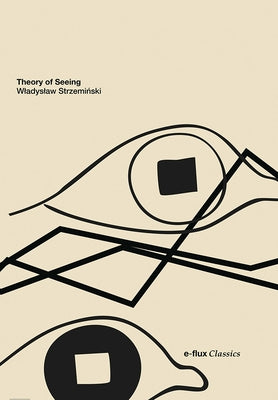
The first English translation of a radical and influential theory of art by a leader of Poland's avant-garde
After World War II, socialist realism became the official state doctrine of art in Poland, with abstract works deemed counterrevolutionary and forbidden from public view. Wladyslaw Strzemiński, a leader of the Polish constructivist avant-garde, developed a treatise of visual consciousness as a foundation for progressive art, emphasizing art's autonomy. His application of Marxist aesthetics to the physiology of seeing is expressed in Theory of Seeing, which was published posthumously in 1958 by his students from notes collected from his lectures.Preceding the comparable perspectives developed by Jacques Rancière, David Hockney, and John Berger, and even the cinema of Jean-Luc Godard, Strzemiński's Theory of Seeing introduces the radical and groundbreaking ideas of one of Poland's most important artists to English-speaking audiences for the first time.
Wladyslaw Strzemiński (1893-1952) was a prominent artist and theorist of Polish modernism. He collaborated with Rodchenko and Malevich, and, with the avant-garde sculptor Katarzyna Kobro, he cofounded the a.r. group, dedicated to advancing modern art. Their efforts led to the establishment of the International Collection of Modern Art at the Muzeum Sztuki in Lódź, Poland, one of the world's first modern art museums. Strzemiński also contributed significantly to art education as a cofounder of the State Higher School of Fine Arts in Lódź.
Daniel Muzyczuk is interim director of Muzeum Sztuki in Lódź, Poland.
Thanks for subscribing!
This email has been registered!
Take 20% off your first order
Enter the code below at checkout to get 20% off your first order