




Before you leave...
Take 20% off your first order
20% off
Enter the code below at checkout to get 20% off your first order

Discover summer reading lists for all ages & interests!
Find Your Next Read
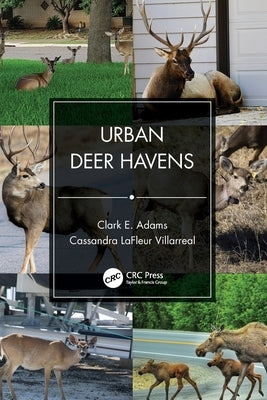
Urban Deer Havens consists of a thorough examination of selected cervid (deer) species that are known to inhabit urban communities in the United States. The deer species that are included in this presentation consisted of white-tailed (Odocoileus virginianus), Key deer (O. v. clavium), moose (Alces alces), elk (Cervus elaphus), mule (Odocoileus hemionus), and black-tailed deer (O. h. columbianus). This book is the first attempt to examine the similarities and differences in those factors that allow the selected cervids to exist and thrive in urban habitats. This information has never been collected, collated, reviewed, and published under one cover document. Yet, all five are known to inhabit urban communities within their geographic range.
The lack of information concerning several important examples of urban cervids in conjunction with a proliferation of information on white-tailed deer only is an incomplete and biased presentation. This book is the first comprehensive source of information on urban deer management, which includes a broad assemblage of urban cervids.
The overall objective of this book is to provide a more holistic examination of urban cervids. For example, it examines the similarities and differences of the environmental impacts, management strategies, and human dimensions considerations concerning urban cervids in general, and using specific examples.
Urban Deer Havens features four chapters that include:
Author: Clark E. Adams, Cassandra LaFleur Villarreal
ISBN-10: 1138305073
ISBN-13: 9781138305076
Publisher: CRC Press
Language: English
Published: 05/24/2020
Pages: 164
Format: Paperback
Weight: 0.58lbs
Size: 9.21h x 6.14w x 0.39d
Review Citation(s):
Choice 07/01/2021
Clark E. Adams was an Emeritus Professor in the Department of Wildlife and Fisheries Sciences (WFSC) at Texas A&M University in College Station, Texas. He received a B.S. in biology from Concordia Teachers College, Seward, Nebraska; an M.S. in biology from the University of Oregon; and a Ph.D. in Zoology from the University of Nebraska - Lincoln. He chaired the Conservation Education Committee for The Wildlife Society (TWS), edited the newsletter for the Human Dimensions of Wildlife Study Group, was a member of the Urban Wildlife Management Working Group, and chaired many committees for the Texas Chapter of TWS. He was a past president of the Texas Chapter of TWS and TWS Southwest Section. Since 1981, he and his students conducted and published many national, regional, and statewide studies on the public's activities, attitudes, expectations, and knowledge concerning wildlife. He developed the degree option in urban wildlife and fisheries management for the WFSC, and developed and taught the senior-level urban wildlife management course. He was the senior author on two other books titled Texas Rattlesnake Roundups (Texas A&M Press, 2008) and Urban Wildlife Management 3rd (Taylor and Francis, CRC Press, 2016). He was the recipient of the 2015 Outstanding Achievement in Urban Wildlife Conservation award from the TWS Urban Wildlife Working Group. Adams completed a 51-year teaching and research career on August 31, 2015.
Cassandra LaFleur Villarreal has worked as an Environmental Specialist in the Dallas/Fort Worth area for over five years specializing in water quality. She received her B.S. in wildlife and fisheries sciences from Texas A&M University in 2014. Cassandra developed an interest in urban wildlife after taking an Urban Wildlife Management course in 2012. In 2013, she began working for Dr. Clark E. Adams as a student worker. While working for Dr. Adams, Cassandra contributed to Urban Wildlife Management, 3rd ed. She developed an alternative method of examining urban biodiversity using literature (peer-reviewed articles and field guides), rehabilitation center intake data, national data sets on bird species per state, and mapping methods such as Global Biodiversity Information Facility (GBIF). She conducted a meta-analysis of the relationship between a species resident by state(s) and observation of that species in an urban setting. This analysis included all native species of terrestrial herpetofauna, birds, and mammals known to exist in the United States. Her analysis and results let to the production of an entire new section and five new chapters in the third edition.
Thanks for subscribing!
This email has been registered!
Take 20% off your first order
Enter the code below at checkout to get 20% off your first order